penne regate with garden fresh parsley pesto and tomato sauce
August 13, 2013 § 56 Comments
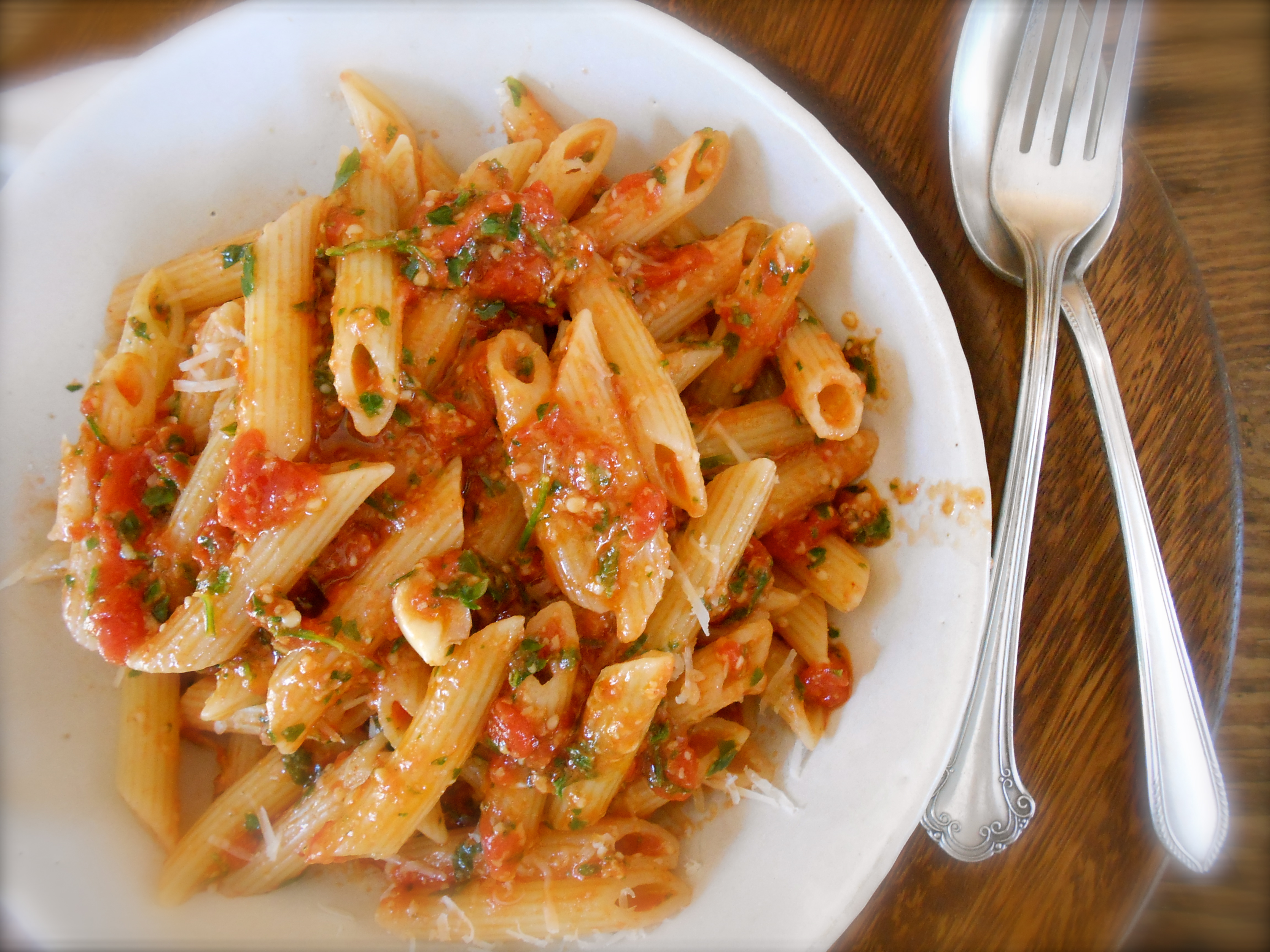
We all have a “go to” dish we have perfected to our liking over time and repetition. Perhaps if you have been checking in with this blog you would guess mine would involve pasta. Cottage Grove House is still very new and there is already sixteen pasta recipes posted. Today’s recipe is my “go to” pasta sauce. When it seems as though there is nothing to eat or prepare in the kitchen I always find some parsley in the crisper (or in this occasion the garden) and a large can of tomatoes in the pantry, perfect to make both pesto and tomato sauce pasta.

Our parsley plant needed a trim so I decided to make a pesto for lunch. I discovered cutting parsley off the plant and promptly using it certainly intensifies the flavor of the pesto. The freshly cut parsley really gave a distinctive flavor to the sauce, as though the herb was still very much alive. For no particular reason I chose to leave out any type of nut for this pesto. And using penne regate pasta was a very good idea seeing that the sauce found it way deep into the hollow center, as well as holding to the exterior ridges.
I n g r e d i e n t s
- 1 pound of good quality penne regate
tomato sauce
- 2 cups whole, peeled, canned San Marzano (if possible) plum tomatoes, with their juices (one 28-oz. can)
- 1/4 cup extra virgin olive oil
- 4 cloves garlic, peeled and crushed
pesto
- handful fresh parsley (about 1 cup once it is finely chopped)
- 1/2 cup freshly grated parmesan
- 3 cloves garlic, peeled
- 1/2 cup extra virgin olive oil
- salt (about 1/2 teaspoon)

m e t h o d
Put a large pot of water on the stove over high heat and bring to a boil. In the meantime, heat 1/4 cup of olive oil in a saucepan over medium high heat. Add the crushed garlic and cook until aromatic. Carefully add the tomatoes, and break them up with the back of a wooden spoon. Bring to a gentle boil, turn heat to lowest setting and simmer, stirring occasionally.
Put the parsley, parmesan, garlic, and salt in a food processor and pulse for a few seconds to combine. Scrape down the sides of the bowl, then pulse again. Drizzle in the olive oil while the machine is running just long enough to incorporate the oil. Set aside while waiting for the pasta to cook.
Once your water is at a roaring boil add a tablespoon of coarse grain salt and drop your pasta in. Cook until al dente, penne regate cooking time is approximately 9 minutes. Drain the penne and return to the pot. Toss with the pesto sauce until well coated, then pour in the tomato sauce and continue to gently toss until well combined.
Serves 4.
fresh corn soup topped with roasted corn guacamole
August 9, 2013 § 64 Comments

The other day I stopped off at Whole Foods on my way home from work to gather something quick for dinner. It was already pushing 6pm and I am usually home and have most of the dinner prep work completed by this time in the evening. Perhaps a caesar salad and something else from the deli would suffice. I walked through the door and the fresh yellow and white corn display brought me to a sudden halt. I could just pick up a few ears to add to the salad idea, but no, my first thought was corn soup! I considered bringing the corn home, look into a soup recipe and make it for dinner tomorrow. Well, knowing corn needs to be prepared the same day you bring it home I decided to step aside and search for a corn soup recipe, right then and there, in Whole Foods. (thank goodness for smart phones) After glancing through the ingredient list from several recipes I found this fresh, spicy, naturally creamy corn soup recipe on Epicurious. I gathered the few ingredients I needed and headed home. Simple enough.

This is similar to a corn chowder, yet lighter and texturally alive with the roasted corn guacamole on top. We loved using fresh corn right off the cob for this soup and we upped the heat a little by leaving the seeds in the jalapeño. It was one of those special soups you’ll never forget. And I always love to hear, “can we have it again…tomorrow?” If you are considering to prepare this soup…which I urge you to do, please be aware I am posting the method exactly the way I prepared it, however, see my note at the bottom of the recipe “Next time I prepare this soup….”
Adapted from Epicurious (reprinted with permission from Simply Mexican by Lourdes Castro).
i n g r e d i e n t s
roasted corn guacamole
- kernels from 3 ears fresh corn
- 1 tablespoon olive oil
- salt and pepper
- 1 tablespoon finely chopped red onion
- 2 tablespoons fresh cilantro, finely chopped
- 1 lime, finely grated zest and juice
- 1 jalapeño, stemmed, 1/2 seeded, finely chopped
- 1 avocado, pitted and diced
soup
- kernels from 5 ears fresh corn
- 2 tablespoons olive oil
- 3 garlic cloves, crushed
- 1/2 red onion, chopped
- 1 jalapeño, stemmed and chopped
- salt and pepper
- 1 1/2 cups stock (vegetable or chicken)
- cilantro sprigs, to garnish
m e t h o d
Preheat your oven to 450°F. Ask someone to “shuck” the corn for you while you start to clean, peel, chop, dice and grate all of the ingredients.
Put the corn on the cob on a parchment lined baking sheet and brush with olive oil, sprinkle salt and pepper and roast for 30 minutes until corn turns a golden brown. Remove the corn for the oven and allow to cool. Slice the corn kernels off of the cob and set aside.

soup
Combine the oil and garlic in a soup pot over medium heat. Once the garlic is aromatic add the onion and jalapeño. Season with salt and pepper and sauté until the vegetables are soft and translucent, about 5 minutes. Add the corn to the pot and using a hand blender puree until it has a smooth texture.
Turn up the heat to medium high and slowly add the stock to the pot while stirring. Bring to a boil, lower the heat to a simmer and allow to cook for 15 minutes.
roasted corn guacamole
Combine the roasted corn, red onion, cilantro, lime zest, lime juice and jalapeño in a bowl and mix well. Gently stir in the avocado. Season with salt and pepper.
Ladle the soup into bowls. Place a generous spoonful of the guacamole in the center of each bowl and a sprig or two of cilantro. Serve right away!
Serves 4.
Next time I prepare this soup…
After preparing this soup I learned it is better to remove the kernels from the cob before roasting them. Not only is this quicker because you do not have to wait for the corn to cool off before slicing the kernels, but it also helps caramelized the corn during roasting which intensifies the flavor of the soup. After cutting the uncooked kernel off of the cob toss in olive oil, salt and pepper and scatter onto a parchment lined baking sheet and roast for 20 minutes in a 450°F oven.
orecchiette with potatoes and arugula
August 2, 2013 § 33 Comments
I could not be happier about this pasta recipe. Years ago, on a number of occasions I frequented an Italian restaurant called La Vecchia Verace and was so enamored by this particular pasta dish. I ordered it every time I visited. Occasionally I think about this pasta and living hundreds of miles away from La Vecchia Verace showing up is not an option. Having said that, the other day I was thumbing through a pasta cookbook “Four Seasons Pasta” by Janet Fletcher and there it was, a recipe for my favorite pasta dish served at La Vecchia Verace restaurant!
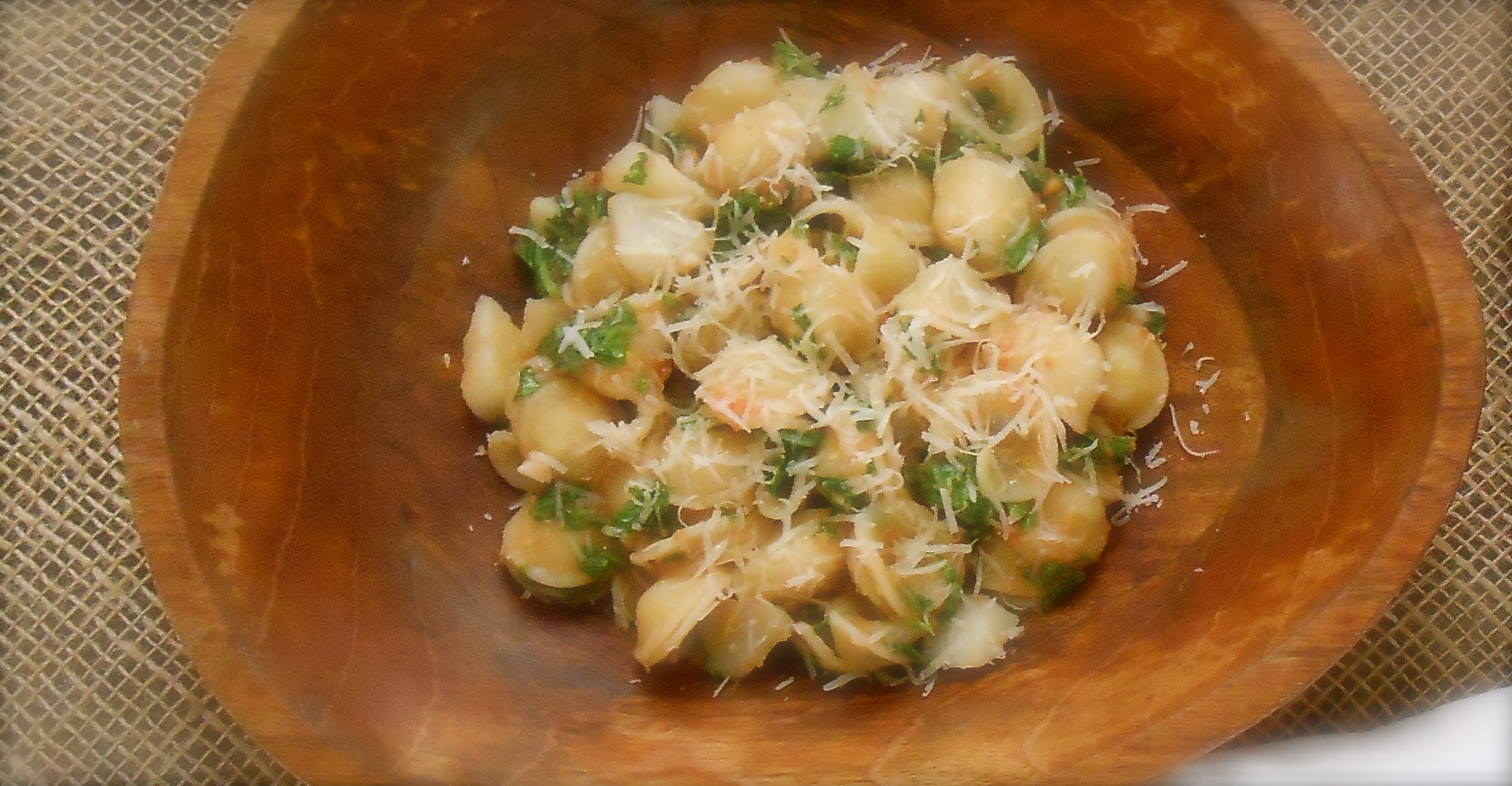
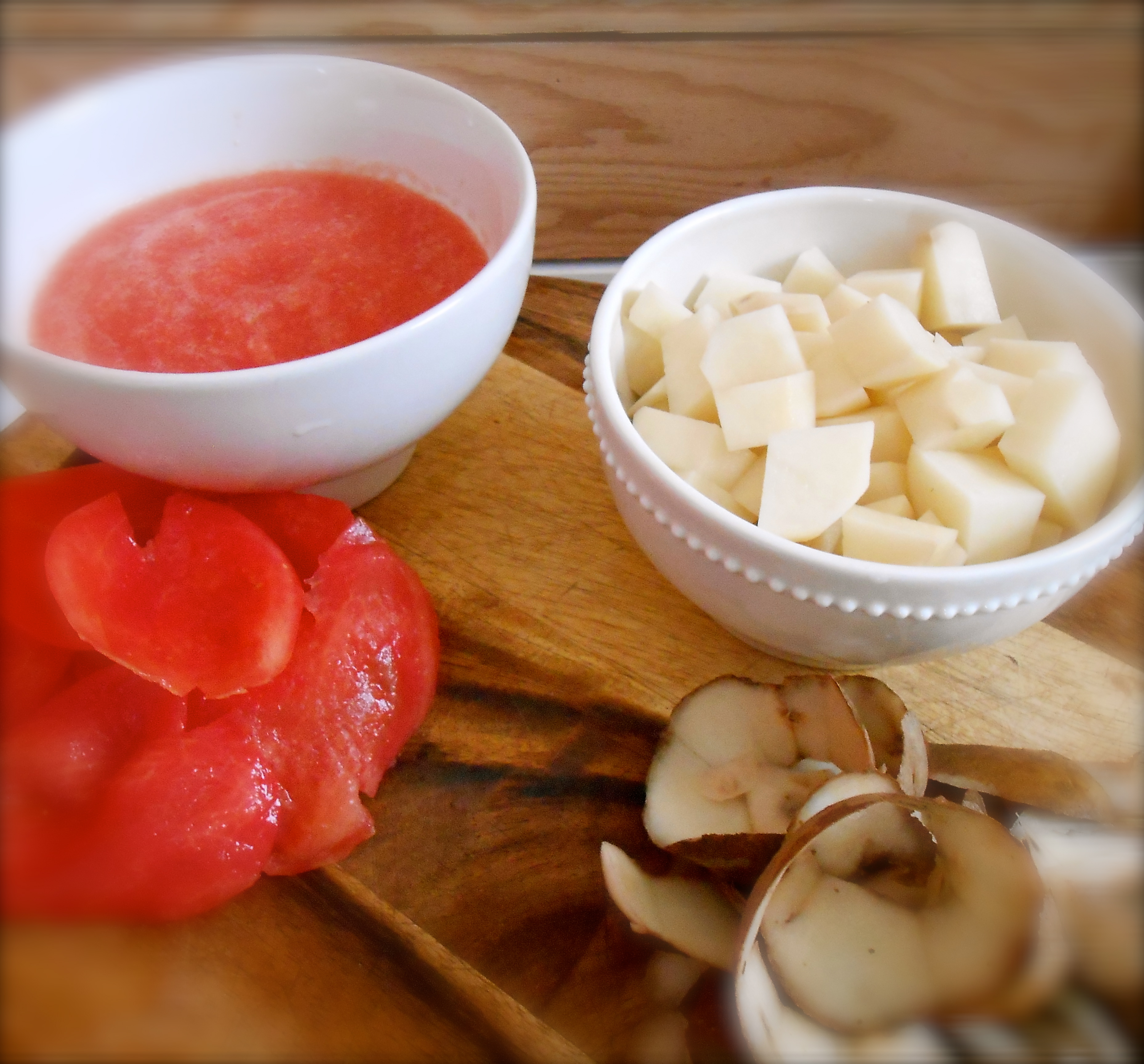
This sauce is garden fresh and the end result is a texturally thick somewhat starchy bowl of summer comfort. Potatoes are boiled in with the pasta until al dente and gently tossed in a fresh tomato sauce with wilted arugula. The potatoes break up just enough to nicely coat the orecchiette. In this cookbook I learned how to use fresh grated roma tomatoes to create a thick, tasty sauce. Roma’s are used because of their high proportion of flesh to juice and they are grated to produce a skinless, seedless pulp. A considerable alternative using fresh tomatoes while in season, rather than open a can of puréed tomatoes.
To grate tomatoes, cut the tomatoes in half and scoop out the seeds and juice with your fingers. Holding the cut side of a tomato half against the grater’s holes, grate until only the thin skin remains in your palm.
Here is a bit of useful information. I read this recently in a Bon Appetit article: “Don’t dump the pasta water. Starchy, salty pasta water is the secret ingredient in most sauces. Scoop out some of the cloudy water (it’s supposed to look like that) with a coffee mug or measuring cup, and pour a few splashes into the sauce. Save the rest; you might need more than you’d expect. Then simmer until the water and oil emulsify and begin to form a slightly creamy sauce. It’s a little like deglazing a pan with stock or wine, a simple step that gives a dish body and flavor.”
For this recipe reserve a cup or two of the pasta water before draining and use it after tossing with the sauce to help the sauce adhere to the pasta. It brings the flavors together and helps moisten the pasta without adding more oil.

I n g r e d i e n t s
- 1/3 cup extra virgin olive oil
- 4 large cloves garlic, minced
- tablespoon hot pepper flakes
- 1 1/2 pounds ripe roma tomatoes, grated
- salt
- 6 ounces (large handful) arugula, coarsely chopped
- 1 pound russet potatoes, peeled, 1/2 inch diced
- 1 pound orecchiettte
- freshly grated grana padano or parmesan
Heat olive oil in a large skillet over moderate heat. Add the garlic and hot pepper flakes and cook for about 1 minute to release the garlic fragrance. Add the tomatoes and salt to taste. Cook, stirring often, until the tomatoes soften and become sauce-like, 15 to 20 minutes, adding water if the tomatoes threaten to cook dry. Stir the arugula into the sauce and cook just until it wilts, about one minute (once the pasta is al dente).
Bring a large pot of salted water to a boil over high heat. Add the potatoes and pasta and cook until the pasta is al dente. Set aside at least one cup of the pasta water, then drain the pasta and potatoes and return them to the warm pot over low heat. Add the sauce and stir gently to avoid breaking up the potatoes. Moisten with some of the reserved pasta water as needed. Divide among warm bowls, top with freshly grated grana padano and serve immediately.
Serves 4.
cool summer borscht
July 31, 2013 § 57 Comments
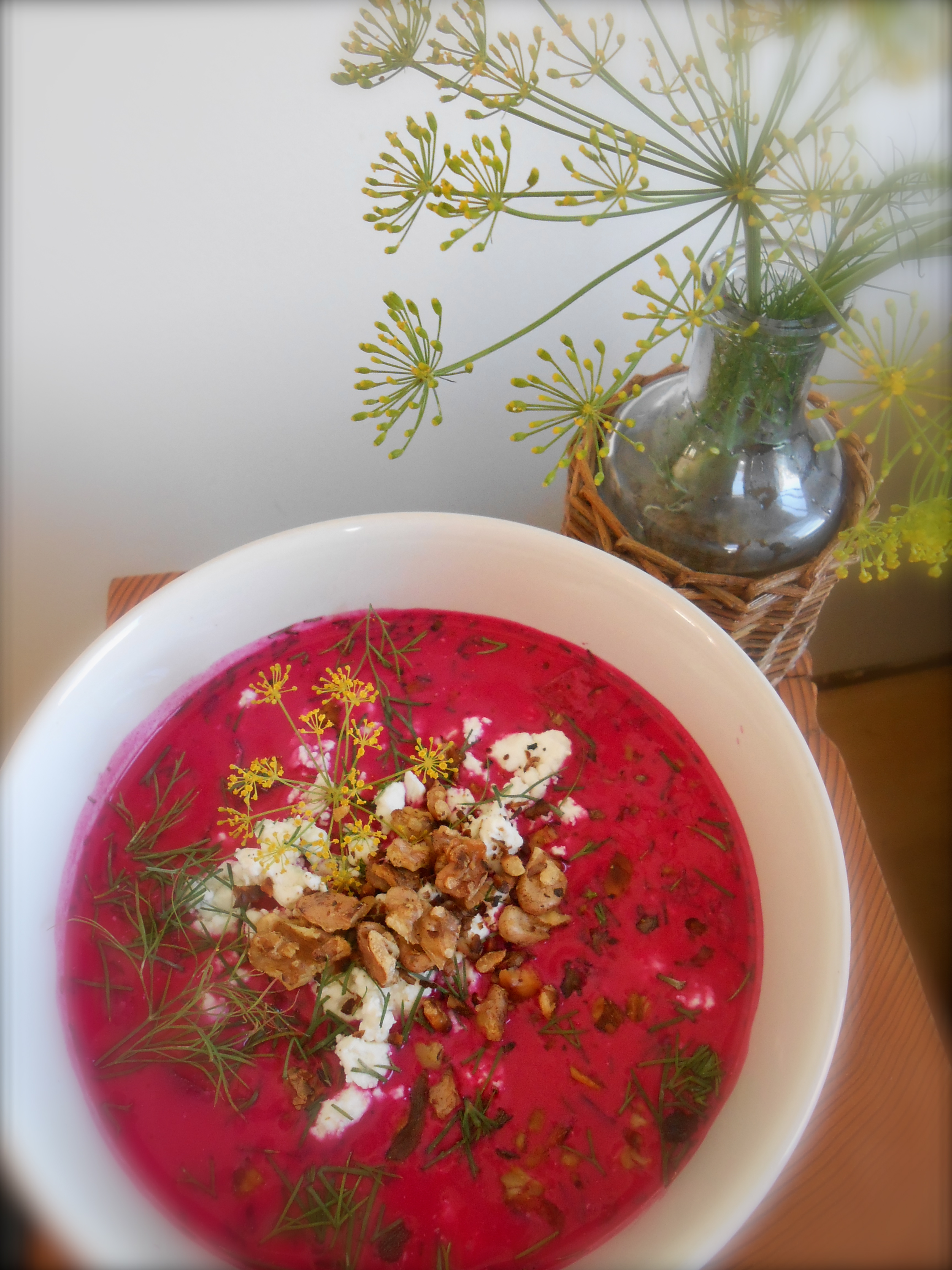
We have a serious affection for beets around here. I have been baking beets every week for the past several, therefore it only seemed natural to seek out a beet soup recipe. I prefer my soups warm with the exception of gazpacho, which to me is much like salsa. I can eat bowls and bowls of gazpacho! Knowing we love beet salad with toasted walnuts and goat cheese I had a feeling we would also enjoy a cool borscht. I read a few recipes, gathered a few ideas and came up with my own palate pleasing soup. Bringing in the beet salad idea we used toasted walnuts and goat cheese crumbles to top it off. A soup and salad in one bowl!
I n g r e d i e n t s
- 5 medium fresh beets
- 2 cups vegetable stock
- 16 ounces greek yogurt
- 2 tablespoons freshly squeezed lemon juice
- 2 teaspoons red wine vinegar
- 1 large cucumber, seeds removed and diced
- 1/2 cup chopped scallions
- 1/2 cup chopped walnuts, dry toasted
- crumbled goat cheese
- 2 tablespoons chopped fresh dill, plus extra for serving

Place the beets in a large pot of boiling salted water and cook uncovered until the beets are tender, 30 to 40 minutes. Remove the beets to a bowl with a slotted spoon and set aside to cool. Strain the cooking liquid through a fine sieve and also set aside to cool.
In a large bowl, whisk together 1 1/2 cups of the beet cooking liquid, the vegetable stock, yogurt, lemon juice, vinegar, salt and pepper.
Peel the cooled beets with a small paring knife or rub the skins off with your hands. Dice the beets into small/medium bite size pieces. Add the beets, cucumber, scallions, and dill to the soup. Cover and chill for at least 4 hours or overnight.
Prior to serving, place the walnut bits in a dry, non stick skillet over medium heat and cook until toasted and brown, giving the skillet a shake every now and them.
Season soup with salt and pepper, serve cool with a sprinkling of crumbled goat cheese, toasted walnuts and an extra sprig of fresh dill.
chicken chilaquiles and jicama slaw
July 29, 2013 § 46 Comments
The other day I roasted a chicken and we didn’t even eat it for dinner! It was one of those days. We are remodeling this old cottage and the weekends are completed devoted to just that, sun up to sun down. I had purchased a whole chicken and didn’t want to freeze it so I roasted it knowing we were not going to be able to have a sit down dinner. I am glad I did because using the chicken the next day for chilaquiles was a delight. Served with jicama slaw.

I n g r e d i e n t s
- 1 small roasted chicken, shredded
- 2 tablespoons olive oil
- 4-5 cloves of garlic, chopped
- 1 can (28 ounces) whole peeled tomatoes in purée
- 3 chipotle chiles in adobo, finely chopped
- 1 tablespoon adobo sauce, from same can of chipotles
- handful of cilantro, 1/2 cup chopped
- tortilla chips, at least 4-6 cups
- 1/2 cup greek style yogurt
- 1/2 cup cotija or feta cheese
Combine the oil and garlic in a large heavy bottom pot. Cook over medium heat, stirring occasionally until the garlic is fragrant, 1 to 2 minutes. Add the tomatoes with their purée, chipotles and adobo sauce and 1 cup of water. Break up the tomatoes, season with salt and bring to a boil. Reduce the heat and simmer until lightly thickened, about 10 minutes. Add the chicken and continue to simmer for 10 minutes. Turn off the heat and add 1/2 cup chopped cilantro. Place a handful of chips in a serving bowl and top with chicken chilaquiles. Make sure to spoon a little extra sauce on each serving. Garnish with cilantro sprigs, greek yogurt and crumbled cotija cheese.

Jicama is such a curious root. “The root’s exterior is yellow and papery, while its inside is creamy white with a crisp texture that resembles raw potato or pear. The flavor is sweet and starchy, reminiscent of some apples or raw green beans, and it is usually eaten raw, sometimes with salt, lemon, or lime juice and chili powder. It is also cooked in soups and stir-fried dishes.” (wikipedia) I simply added lime, a little thinly sliced red onion, cilantro, salt and pepper. This was so cool and refreshing alongside the warm, spicy chilaquiles. This was a perfect matched dinner, texturally speaking. The soft spicy chilaquiles, creamy yogurt, crunchy tortilla chips and the crispy cool jicama all together sang in harmony with each bite.
I n g r e d i e n t s
- 1 medium jicama, peeled and juliennned
- 1/4 – 1/2 small red inion, thinly sliced
- 1/2 cup coarsely chopped fresh cilantro
- 3 tablespoons fresh lime juice
- coarse salt and pepper
I did not want the red onion to be dominant in this slaw. Use what your palate enjoys and play around with the lime juice as well.
In a medium bowl place all the ingredients and toss well. Serve right away, or allow to marinate in the refrigerator for up to 6 hours.
Serves 4.
summer linguine with fresh hand formed mozzarella
July 24, 2013 § 49 Comments
Right now heirloom cherry tomatoes are starting to appear in the markets in great quantities and I could not be happier. Although I have five different cherry sized heirloom varietals growing in my own garden, which still need a few more weeks to ripen, I found myself with a basket of them at the checkout stand. This particular market makes their own hand formed mozzarella and offers the best artisanal crusty breads the city has to offer. With my greek basil bush doing so well I decided I would make bruscetta “caprese style” for lunch today.

We sliced the tomatoes in half, put them in a bowl with fresh bush basil leaves, a drizzle of olive oil and a sprinkling of salt. We let it sit and marinade for 30 minutes. The tomatoes were placed on top of crusty bread and a slice of fresh mozzarella. A fabulous lunch, of which I did not photograph.
With a large bowl of marinaded tomatoes and half of the fresh mozzarella left I extended the caprese idea into a summer pasta.
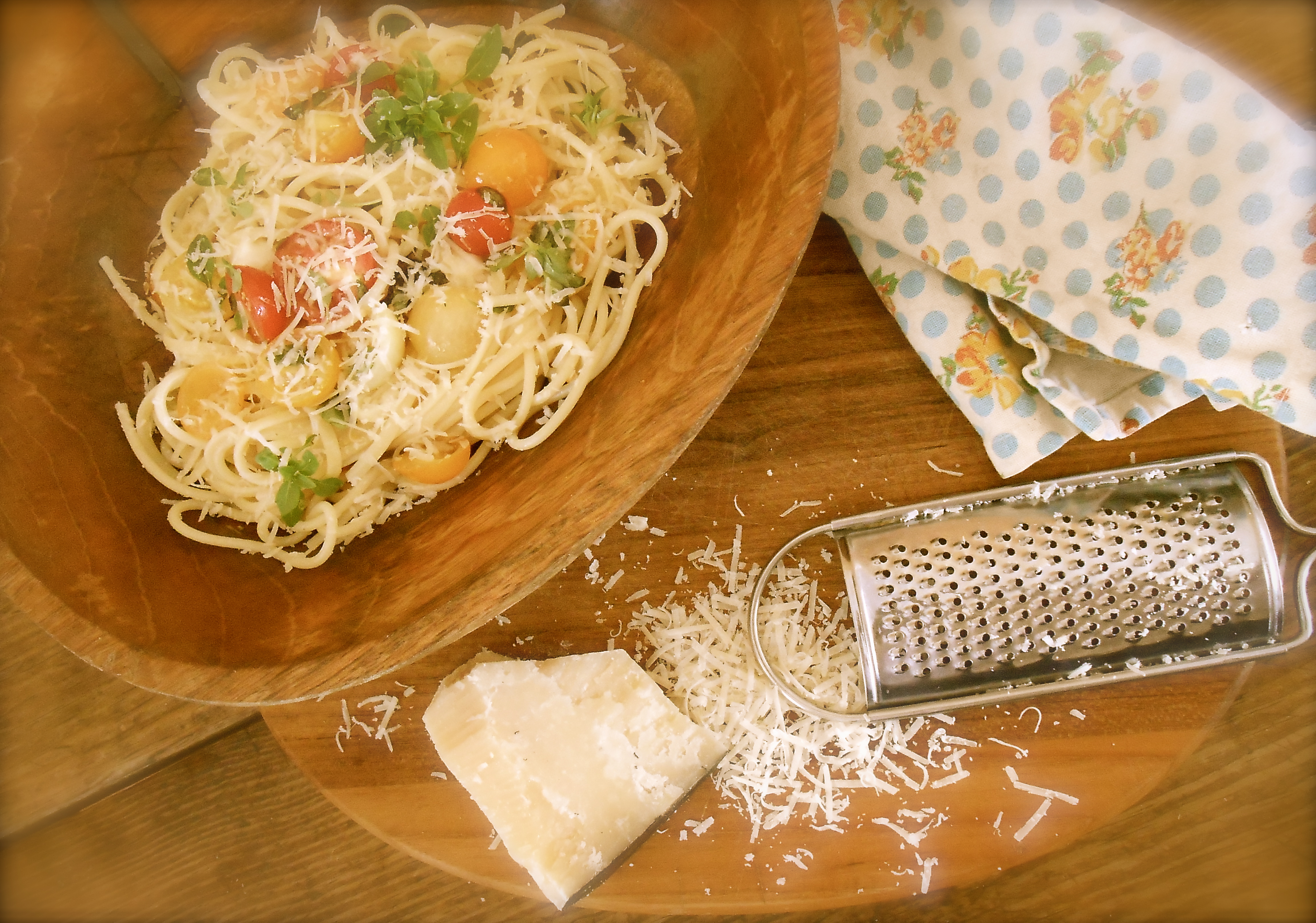
To the marinaded tomatoes I added minced garlic, a little more basil and some of the best cheese I have had in awhile…Grana Lodigiano. A hard texture cheese much the same as Grana Padano. I liked it’s black rind which I learned is a tradition held onto for centuries. In ancient times the wheels were matured with a clay coating, grapeseed oil and charcoal. This compound gave it a black hue. Today the wheels are still hand coated with natural ingredients to create the same black hue to specifically set it apart from Parmesan. I do enjoy talking with the cheese monger at the market…
I n g r e d i e n t s
- 1 pint of heirloom cherry tomatoes, halved
- 4 cloves garlic, minced
- 1/2 cup shredded basil leaves
- 8 ounces fresh hand formed mozzarella cheese, diced
- 1/2 cup olive oil
- 1/4 cup reserved pasta water
- sprinkling salt and black pepper
- 3/4 pound linguine
- 1/2 cup freshly grated Grana Lodigiano cheese or Parmesan cheese
M e t h o d
Place the tomatoes, garlic basil, mozzarella, olive oil, salt and pepper in a large serving bowl. Stir to mix and set aside at room temperature for at least 1 hour. Cook the pasta until al dente. Drain briefly, reserving 1/4 cup of pasta water. Add pasta and reserved water to the tomato mixture. Add the Grana Lodigiano and toss to mix. Serve right away while the pasta is still warm.
Serves 4.
buon appetite
flounder salad
July 12, 2013 § 35 Comments
I found fresh wild caught flounder at the market the other day. My plan was to go home and make tacos. I knew I wanted something lightly spiced with garlic and herbs. What I didn’t expect was the flavor and texture of this fish to be astoundingly delightful. Once I tried a taste I knew this would be a great fish for salad and I gave up on the taco idea.

I dusted the flounder lightly with flour, added a little salt and pepper and pan cooked it in hot olive oil. Once the flounder was cooked, using the same pan, I added chopped garlic, cilantro, a squeeze of lemon juice and a sprinkling of pimentón de la vera (sweet smoked paprika). Topping the flounder with these crispy spicy bits was simply delectable.
The flounder was served on a bed of mixed wild greens, topped with grated purple cabbage, tzatziki, cilantro sprigs and a few lime slices. I made the tzatziki before starting the fish. I highly recommend using this in place of a salad dressing.
I n g r e d i e n t s
- 1.5 pound fresh wild caught flounder filets
- 4-5 tablespoons olive oil
- 1/4 cup flour
- salt and pepper
- 3 garlic cloves, chopped
- 1/2 cup cilantro, coarsely chopped
- juice of 1/2 lemon
- 1 teaspoon sweet smoked paprika (or to taste)
- three handfuls of mixed wild greens
- 1/2 cup grated purple cabbage for serving
- a few springs of cilantro for serving
- lime slices for serving
Wash the flounder and pat it dry with paper towels. Set a large skillet over medium high heat and add 3 tablespoons of olive oil. Dust both sides with flour. Set the fish in the skillet, sprinkle with salt and pepper and cook for 3-5 minutes until golden. Turn the fish and sprinkle the other side with salt and pepper. Continue to cook until golden and crisp around the edges. Remove the fish from the pan to clean paper towels. Turn the heat to low and add cilantro and garlic to the skillet. Mix around and when it has become aromatic add the lemon juice and allow it to bubble a little. Sprinkle the smoked paprika, move around with a spatula until well combined and a bit crispy. Turn off heat.
Plate each serving. First a handful of mixed greens, fish, crispy/spicy bits, a little grated purple cabbage, tzaziki, cilantro sprig and a few lime slices.
Serves 4.
conchiglie with yogurt, peas and chile
July 10, 2013 § 60 Comments
I love visiting food blogs specifically looking for something to prepare for dinner…”tonight”! The other day I visited one of my favorite blogs (I have too many to count) and found this recipe. I am a huge fan of Molly’s blog and I took heed to her urgency about cooking this pasta. I ran out and pick up what I needed, came home that late afternoon and made one of the most delicious pasta dishes we have ever had. I never imagined pasta prepared with yogurt sauce. This was so creamy, yet light, a bit spicy from the chile, yet a little sweet from the peas, nutty from the pine nuts and lightly salty from the feta. All melty hot and delicious.
I have yet to pick up my copy of Jerusalem, by Yotam Ottolenghi and Sami Tamimi. Convincingly after making this recipe I am heading out today to do so.
I could never in my wildest dreams come up with this so I am giving you Molly’s posted recipe “verbatim”. And if you haven’t read Molly’s book A Homemade Life it is quite charming and features some incredible recipes.

A s w r i t t e n o n O r a n g e t t e . . . .
Pasta with Yogurt, Peas, and Chile
Adapted slightly from Jerusalem, by Yotam Ottolenghi and Sami Tamimi
The original version of this recipe calls for conchiglie, or shell-shaped pasta, but you could use any small pasta shape you like: orecchiette, penne, farfalle, and so on.
If you have some exotic type of dried chile, like Urfa chile, Aleppo chile, or Kirmizi biber, you lucky lucky dog, this is a great place to use it. If not, you can use regular red pepper flakes. I happened to have some Aleppo chile, and though it was ground, not in flakes, and probably a few years old, it worked beautifully. Oh, and if you’re worried about the amount of heat, consider starting with a little less of the chile than what is called for – or just don’t put much chile oil on your pasta.
- 2 ½ cups (500 g) whole-milk Greek yogurt
- 2/3 cup (150 ml) olive oil
- 2 medium cloves garlic, crushed or pressed
- 1 pound (500 g) fresh or thawed frozen peas
- Kosher salt
- 1 pound (500 g) pasta shapes of your liking
- Scant ½ cup (60 g) pine nuts
- 2 teaspoons Turkish or Syrian chile flakes, or red pepper flakes
- 1 2/3 cups (40 g) basil leaves, coarsely torn
- 8 ounces (240 g) feta cheese, coarsely crumbled
In the bowl of a food processor, combine the yogurt, 6 tablespoons (90 ml) of the olive oil, the garlic, and 2/3 cup (100 g) of the peas. Process to a uniform pale green sauce, and transfer to a large mixing bowl.
Bring a large pot of water to a boil, and salt it until tastes like pleasantly salty seawater. Add the pasta, and cook until it is al dente. While the pasta cooks, warm the remaining olive oil in a small frying pan over medium heat. Add the pine nuts and chile flakes, and cook for 4 minutes, or until the pine nuts are golden and the oil is deep red. Also, warm the remaining peas in some boiling water (you could scoop out a bit of the pasta water for this); then drain.
Drain the cooked pasta into a colander, and shake it well to get rid of excess water that may have settled into the pasta’s crevices. Add the pasta gradually to the yogurt sauce; adding it all at once may cause the yogurt to separate. Add the warm peas, the basil, feta, and 1 teaspoon kosher salt. Toss gently. Serve immediately, with pine nuts and chile oil spooned over each serving.
Yield: about 6 servings
spaetzle with brown butter sage
July 8, 2013 § 35 Comments
I made spaetzle this weekend. I have been wanting to make this for years and decided it would be a nice side dish with our grilled salmon. I searched around and found several recipes which all differed slightly. I got caught up in the Smitten Kitchen blog reading her post and the 400+ comments regarding her spaetzle. I ended up using a recipe from this blog. I really like her uncomplicated approach. It was just what I needed when I was feeling a little intimidated by the numerous other recipes. Some things need not be complicated. Spaetzle is one of them. I used brown butter and sage to flavor the spaetzle, then at the last minute I added cream. In hindsight the cream was unnecessary. I knew it right when I poured it in the skillet. However, it was out of this world delicious! As comforting as a good homemade mac and cheese. If you are serious about making spaetzle take a look at The Tasty Kitchen blog for a detailed tutorial.
- 2 whole Eggs, Beaten
- ¾ cups Water
- 1-½ cup All-purpose Flour
- ¼ teaspoons Salt
- drizzle of olive oil
- 2 tablespoons butter
- 5 large fresh sage leaves, sliced
- 1/2 cup cream (optional)

Bring a large pot of water to boil and add a bit of salt .
Add flour and salt to a large bowl and mix together. Beat the eggs and add them to your flour mixture. Add water and stir well to work out all the lumps.
Using your colander and spatula, pour the dough into the colander. Keep the colander above the steam so it doesn’t cook before it gets pushed through the holes. Press the batter through the colander with the spatula. Drops will fall into the water and cook instantly. Boil for 3 to 4 minutes. Remove the spaetzle from the water and strain it into a bowl. Toss with a bit of olive oil to prevent it from sticking together.
Heat the butter in a large skillet over medium high heat. Add the sage cook until aromatic. Toss in the spaetzle and brown to your liking. Here is where I added the cream (unnecessary) and allowed to simmer for 5 minutes stirring occasionally.
Serves 4, as a side dish
orecchiette pasta with cilantro pesto
July 1, 2013 § 32 Comments
We are finally having HOT sunny days here in Seattle. Thank goodness for the tomato plants who have been very patiently waiting for the sun during the past three weeks. Seattle can be a unkind to tomatoes. Typically my plants are late bloomers and by the time their skins should turn red a blanket of clouds cover the sun once again leaving them an orange hue rather than red and a good supply of green ones too. I have learned it is best to plant “little” tomatoes such as cherry, grape, sun gold and/or a medium size roma varietal for our short lived tomato growing season. However, it could just be me and my lack of tomato growing knowledge.

s u g a r p l u m g r a p e t o m a t o e s
I have a pasta recipe here which requires only one burner on your stove for boiling the orecchiette. A summery fresh pasta while keeping the heat out of the kitchen!
I n g r e d i e n t s
- 1 pound good quality orecchiette
- 2 bunches cilantro, washing and thick stems removed
- 3 cloves garlic, smashed and peeled
- 1/2 cup pecans
- 1/2 cup olive oil
- 2 heaping tablespoons plain greek yogurt
- 1/2 cup grated parmesan cheese
- salt to taste
- sugar plum grape tomatoes
Bring a large pot of salted water to a boil. Add the pasta, and cook until it is al dente. While the pasta cooks prepare the pesto.
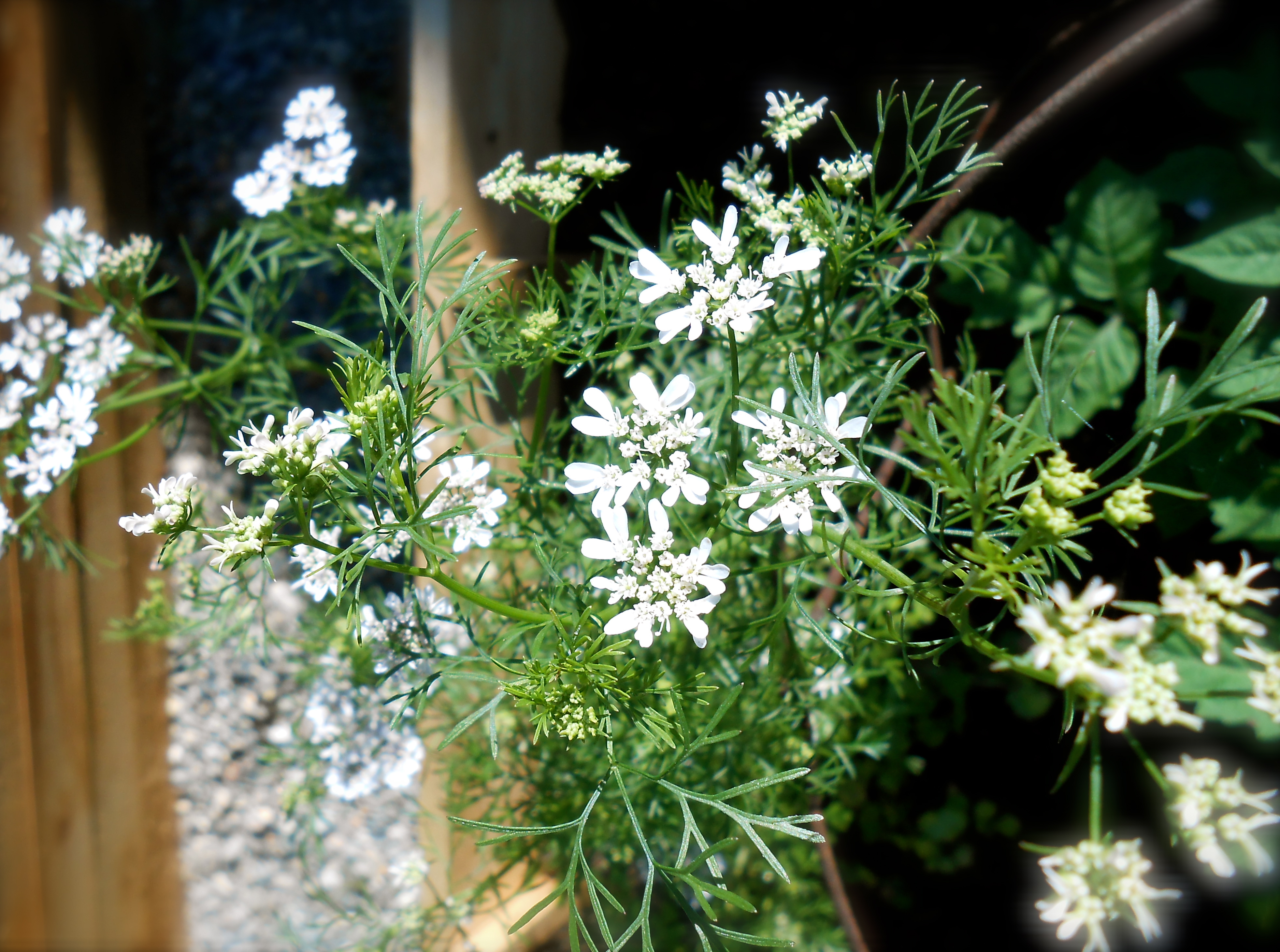
f l o w e r i n g c i l a n t r o
Place cilantro in food processor and whizz until finely chopped. Add the remaining ingredients and whizz until it is a well mixed pesto.
Slice sugar plum grape tomatoes into small bits and set aside.
Drain the cooked pasta without shaking the colander too much leaving a trace amount of the cooking water. Return to the pot and stir in the pesto. Taste to see if you need to salt. Place in serving bowls topped with sliced sugar plum tomatoes and a sprinkling of freshly grated Parmesan.
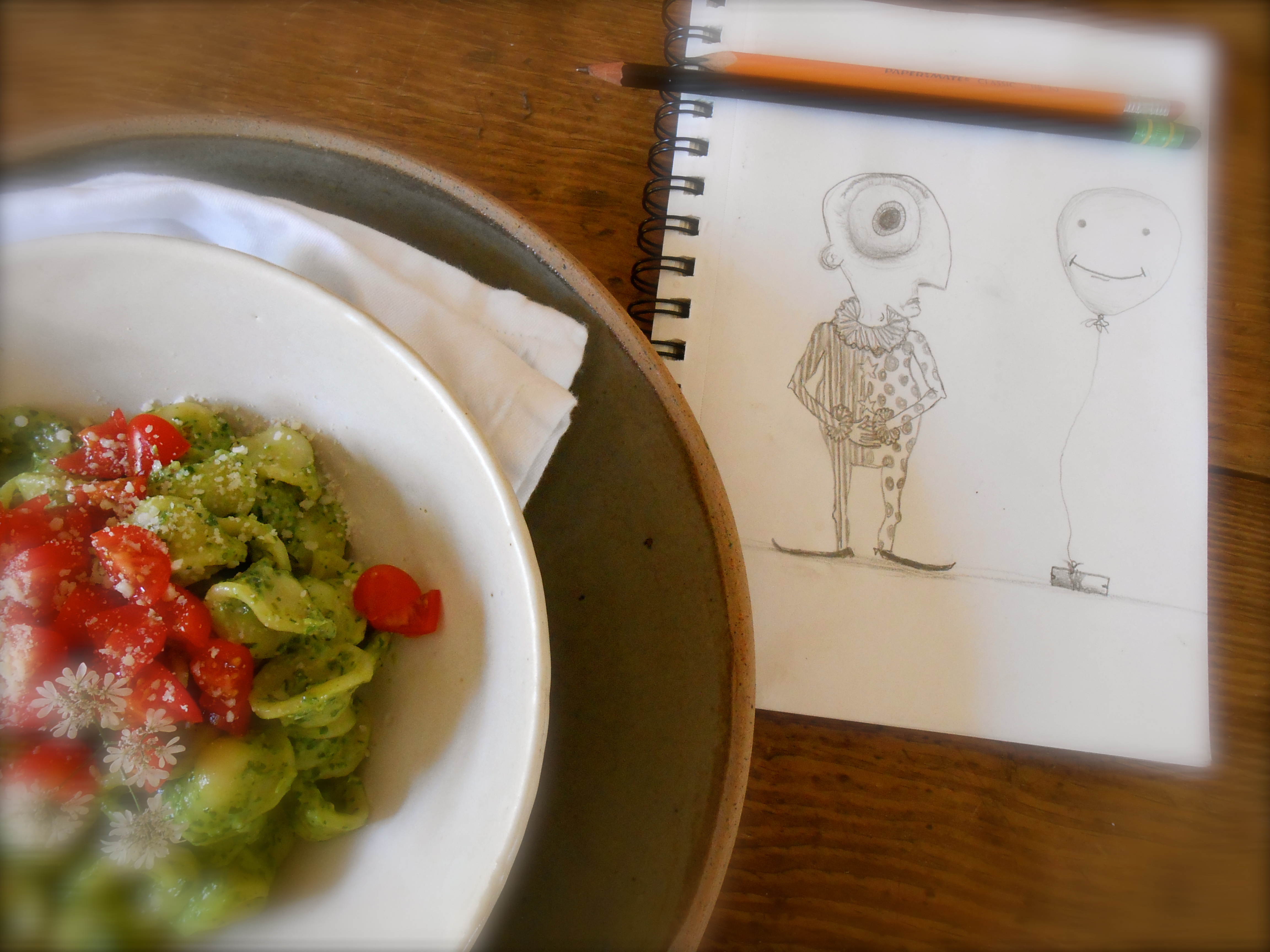
orecchiette pasta with cilantro pesto and a page in my son’s drawing journal
Serves 4
buon appetite.
 COTTAGE GROVE HOUSE